|
Weekly Report from Peter Huessy on January 6, 2025
|
How Biden Screwed the Steelworkers 1/3/2025
Japan, one of our closest allies, wanted the deal. So did Pittsburgh steelworkers and members of the president's cabinet. So why did he block it?
By Ethan Dodd
Back in April, when President Joe Biden was still running for reelection, he told a gathering of steelworkers in Pittsburgh that “I have your back.” On Friday afternoon, just three weeks before leaving office, he stuck a knife in their backs.
He did so by blocking Japan’s Nippon Steel’s proposed $14.9 billion purchase of the once-iconic, now-declining U.S. Steel. The ostensible rationale was “national security.” As Biden put it in a statement Friday morning, “It is my solemn responsibility as president to ensure that, now and long into the future, America has a strong domestically owned and operated steel industry.” He added, “And it is a fulfillment of that responsibility to block foreign ownership of this vital American company.”
If only. Blocking the deal is just going to hurt the U.S. steel industry, and everyone in the industry, including the workers themselves, knows it. The real reason Biden stopped Nippon Steel from buying U.S. Steel was politics—a combination of placating his union allies and a misguided belief that U.S. Steel must remain in American hands at all costs. The irony is that this economic nationalism and union nostalgia could kill 3,000 union jobs and push U.S. Steel out of Pittsburgh.
During the election, the proposed takeover of U.S. Steel by a Japanese company became a heated issue in Pennsylvania. While Biden and Vice President Kamala Harris cited national security concerns, Donald Trump said in a Truth Social post that the tariffs he planned to place on imported steel would revive the industry. The far more likely result, however, is that Pennsylvania steelworkers will soon be out of work, as U.S. Steel had vowed to move to non-union Arkansas if its deal with Nippon Steel were turned down.
“They’re simply being ignorant and unknowledgeable,” Troy Stephenson, treasurer of United Steelworkers (USW) Local 2227, told The Free Press. “They pride themselves on foreign investments and saving jobs, and that’s not what they’re about,” added the fourth-generation steelworker, who, like many of his peers, voted for Trump.
“If there’s no company, what good are tariffs?” said Andy Macey, a mechanical repairman at U.S. Steel’s Clairton Works. Macey, 70, was a steelworker in the 1980s when U.S. Steel, unable to compete with cheap foreign imports—much of it from Japan—began shutting down factories. “When I walked out of that steel mill with my coworkers, we had tears in our eyes,” he said, remembering the daily food and unemployment lines. Macey said that a locker buddy committed suicide the night he was laid off. He pushed for the Nippon deal because he didn’t want younger steelworkers to suffer the same fate.
U.S. Steel is now down to 20,000 workers from its high of 340,000 in the 1940s. In 2021, it scrapped a $1.5 billion upgrade to the Mon Valley Works in the Pittsburgh area and purchased a new lower-cost steel mill in Arkansas instead, closing older mills and laying off 4,000 union workers as it idled mills in St. Louis and Detroit. When Nippon Steel offered to buy U.S. Steel in late 2023, it could have been—should have been—the U.S. company’s salvation.
Nippon Steel promised to invest $2.7 billion in U.S. Steel’s aging union facilities, including $1 billion in the Mon Valley. The Japanese even sweetened the pot with a $5,000 bonus for workers if the deal passed.
In recent weeks, in a last-ditch effort to save the deal, Nippon Steel made a series of even more extravagant promises, including offering the federal government a veto over any reduction in U.S. Steel’s production capacity, and a “full-time board observer.” And it agreed to provide U.S. Steel with “sufficient resources” to pursue trade complaints against foreign steel producers, including their Japanese owners—a remarkable concession.
But none of it was enough.
U.S. Steel's Clairton Coke Works rests along the Monongahela River in Clairton, Pennsylvania on December 17, 2024.
Local union leaders from two of the three Mon Valley plants supported Nippon, with Jason Zugai, vice president of USW Local 2227, saying that 95 percent of the union members at his Irvin Works support the deal. U.S. Steel’s corporate executives, elected officials, and hundreds of workers rallied to show their support in late November. That same month, Japanese prime minister Shigeru Ishiba warned in a letter to Biden that blocking the deal would “cast a shadow on the achievements you have accumulated over the past four years,” weakening an alliance critical to countering China.
But none of that support could override the fierce opposition of the national United Steelworkers brass, who endorsed Biden in 2020 and again in 2024 before he dropped out. USW president David McCall claimed Nippon intended to shut down Mon Valley steelmaking and subject American steel producers to Japanese dumping, a threat to U.S. national security and supply chains—claims that Nippon Steel has vehemently disputed.
McCall wants U.S. Steel to come crawling to its Ohio-based rival Cleveland-Cliffs, which made an unsolicited offer to buy it out in 2023 and lost a bidding war to the much wealthier Nippon. Waiting in the wings for Biden to block the Japanese steel giant, Cleveland-Cliffs CEO Lourenco Goncalves called Japan “not a friend” in March.
Goncalves couldn’t be more wrong. Japan is one of Uncle Sam’s closest allies. It harbors the Seventh Fleet of the U.S. Navy and is our largest source of foreign direct investment. The U.S. has insisted that the Japanese hold back their semiconductor equipment exports to help the U.S. maintain its competitive edge in the AI race with China, our actual foe. Why should Japan partner with us if we ignore their government’s pleas and block investment in American steel?
Shortly before Christmas, the Committee on Foreign Investment in the United States, which is part of the executive branch and includes representatives from a number of cabinet departments, found itself unable to come to a unanimous decision about whether or not the Nippon Steel deal should be stopped. According to the Financial Times, the three most important committee members—the Treasury Department (which leads the committee), the State Department, and the Pentagon—found no security risks. In other words, in kowtowing to a union leader who has been a long-time political ally, Biden ignored the wishes of an important ally, Japan; members of his own cabinet; and the union workers themselves. He is also hurting the country, which would be far better served if Nippon Steel reinvigorated U.S. Steel, something it is uniquely positioned to do.
A final irony: On the same day Biden blocked the Nippon Steel deal on “national security” grounds, the U.S. approved the sale of $3.6 billion worth of air-to-air missiles to Japan.
It’s all so needless. The president’s political life is over. Yes, he’s spent his long career portraying himself as a friend of unions, and especially of unionized steelworkers. But blocking the Nippon Steel deal will simply add to his already tarnished legacy.
California Dreaming: SF and California Coming to their Senses!!
San Francisco Starts Ban on Cash Welfare for Drug Addicts Who Refuse Treatment
Bill Connor
Colonel, US Army (Ret)
January 3, 2025
Guest Editorial on Religion in America
|
For most conservative Americans, the election of Donald Trump felt like a miracle. The years of biased negative media coverage and lawfare seemed insurmountable. We had good reason to believe that another Democratic administration would end any chance for conservatives to come back to power. The open border illegal immigration under the Biden Administration allowed for millions to be spread throughout the nation and particularly battleground states. Attempting to grant amnesty and voting rights to likely Democrat voters would have created an indefinite Democratic Party monopoly. The expansion of the critical race theory into all aspects of American life would have continued. Speech restrictions against conservatives would have suppressed the ability to criticize the progressive onslaught. Thankfully, Trump won. Though the election helped stop the near-term damage, a national turn back to God is what is most needed for the long-term health of the Republic. After the election, both Gallup and the Wall Street Journal (WSJ) conducted surveys tracking the importance of religion to Americans along with trends over decades. The results were shocking in the level of steep decline. The data showed that in 1998, a whopping 62% of Americans rated religion as “very important”; by 2019, that number dropped to 48%. Even more alarming is that the decline accelerated, now only 39%. Gallup asked about the importance of religion in daily life, and the answer “very important” declined from 60% in 1998 to only 45% now. https://news.gallup.com/opinion/polling-matters/544508/measuring-trends-americans-personal-values.aspx The bottom line is that the decline in religion in America is steep and appears to be speeding up. While religion has been declining at these alarming rates, America has suffered a steep moral decline. Of all the indicators of decline, including exponentially higher single parenthood rates, is the overall marriage rate. In 1970, the overall marriage rate was at 76.5%. Yet, by 2023 that number was well under half at 31.1% https://www.nationalreview.com/news/u-s-marriage-rate-has-declined-60-percent-since-1970-study-shows/ Importantly, this marriage decline started in the 1970s, but sped up substantially in the 1990s like the religious decline. In the 2000s, states began to expand the definition of marriage beyond Biblically based, traditional marriage. At that time, the substantial majority of Americans were opposed to gay marriage. In 2008, the major Democratic Party Presidential candidates, including Hillary Clinton, Joe Biden, and Barack Obama, publicly opposed gay marriage. By 2015, the Supreme Court ruled gay marriage a Constitutional right, and the majority of Americans came to support it. Until around a decade ago, the ideological extremes of transgenderism of the Democratic Party, including forceful demands for minor transsexual medical procedures, were outside everyday discourse or thought. They have become mainstream. With the moral decline following the religious slide, voices attempting to uphold traditional Biblical morality became the target. Parents at school boards attempting to keep formerly depraved practices away from their children, like drag queens and transgenderism, became targets of Federal law enforcement. What had been previously viewed as positive by most in society, like Patriotism and Biblical morality, came to be stigmatized as indicators of “extremism” or “white supremacy” by many in power. As Americans discovered after Elon Musk purchased Twitter, the Federal government had been pressuring big tech to censor and suppress conservative and religious voices, particularly if those voices opposed progressive ideology. Organizations like the Boy Scouts were undermined, and children were taught to question their God-given sexuality. Those opposing this depravity were called “bigots” and worse. The new administration will be able to roll back the moral decline from within the Federal government through new orders and rules. They can stop the government from targeting what was previously respected as a positive good. They will face much pushback from those who have marinated in progressive ideology for decades but can win. This will allow marriage to flourish again and men and women to find happiness in how God created them. The greatest challenge will be with the change in the hearts of most Americans. Throughout our nation’s history, we have risen to greatness as a uniquely God-fearing people. As Alexis de Tocqueville put it in the 1830s, “There is no other nation on Earth in which the Christian religion retains a greater influence over the souls of men as in America.” Many historians credit the Christian revival of the First Great Awakening in America as having pushed America towards the Revolution. A ubiquitous Battle cry during the Revolution was “We have no King but Jesus,” not King George III https://fse.life/2014/07/23/americas-christian-heritage-no-king-but-jesus/. The distinctive religious character of the American people set them apart. In the National Prayer for the D-Day invasion in 1944, President Roosevelt named “our religion” among what we were fighting to defend. Famed British Historian Paul Johnston claimed “America is, and always has been a religious country” and that American exceptionalism was due to America being “Godfearing, and all that entails” https://www.aei.org/research-products/speech/writing-a-history-of-the-american-people/. As the new administration takes power and attempts to turn the government away from the morally deviant path of the last years, it is incumbent that America turns back to God. I pray that 2025 will witness the beginning of a great revival that our nation so desperately needs. A Look at the Prime Terrorism State Sponsor—Iran---in light of the New Orleans and Vegas terror attacks. For those of you interested in Iran as well as 9-11, I highly recommend the following essays from In Focus magazine, published by the Jewish Policy Center here in DC. It is the top journal on a variety of national security and foreign policy issues and comes out quarterly. I recommend you read the essay by Clare Lopez on 9-11. |
A Comprehensive Strategy for Democratic Transition in Iran – Gregg Roman
The Curious Case of Iran’s Destroyed Nuclear Site – Andrea Stricker
How to Bring Back Maximum Pressure on Iran – Richard Goldberg
Rethinking Iran’s Future – Ilan Berman
Defeating Islamist Iran – Kenneth R. Timmerman
The Attacks of 9/11: Why They Still Matter – Clare M. Lopez
The Push to Ban Fossil Fuels—A Perspective
Germany is adopting wholesale the green agenda. Victor David Hanson is one of the top thinkers in America today and what Germany is doing is the same as what California and Maryland also seek to implement. Germany’s New Morgenthau Plan by Victor Davis Hanson | January 03, 2025
Victor Davis Hanson is a classicist and historian at the Hoover Institution at Stanford University, and author of the book "The Second World Wars: How the First Global Conflict Was Fought and Won." You can reach him by e-mailing [email protected].
Less than a year before the end of World War II, then-U.S. Secretary of the Treasury Henry Morgenthau drew up a nightmarish plan to punish postwar Germany.
After the serial 1870-1871 Franco-Prussian War, World War I, and World War II—along with the failed Versailles peace treaty of 1919—the Allies in World War II wanted to ensure there would never again be an aggressive Germany powerful enough to invade its neighbors.When the so-called Morgenthau Plan was leaked to the press in September 1944, at first it was widely praised. After all, it would supposedly render Germany incapable of ever starting another world war in Europe.
Morgenthau certainly envisioned a Carthaginian peace, designed to ensure a permanently deindustrialized, unarmed, and pastoral Germany.Postwar Germany would have resembled something akin to the ancient, pre-civilized frontier that the first-century AD historian Tacitus wrote about in his Germania.The plan would have ensured that within six months of Germany’s surrender, all of its industrial plants and equipment were to be dismantled.
The Ruhr, the renowned center of European industrial strength, was to be permanently neutered, starved of its energy, raw materials, and infrastructure.After the war, the plan demanded virtual complete disarmament of Germany. Its once-feared armed forces were to be rendered nonexistent. There were also promised massive reductions in Germany’s borders. Various countries, such as the Soviet Union, Poland, and France, were to be given large slices of the old Third Reich.
Future German security would hinge only on the power and goodwill of the victorious United States and its allies.When the dying Nazi Party got wind of the plan, Adolf Hitler’s propaganda minister Joseph Goebbels had a field day. He screamed to Germans that they were all doomed to oblivion if they lost the war, even growing opponents of the Nazi Party.
Even many Americans were aghast at the plan. Gen. George Marshall, the Army chief of staff, warned that its mere mention had galvanized German troops to fight to the end, increasing American casualties as they closed in on the German homeland. Ex-President Herbert Hoover blasted the plan as inhumane. He feared mass starvation of the German people if they were reduced to a premodern, rural peasantry.
But once the victorious allies occupied a devastated Germany, witnessed its moonscape ruined by massive bombing and house-to-house fighting, and discovered that their “ally” Russia’s Josef Stalin was ruthless and hellbent on turning all of Europe communist, the Harry Truman administration backed off the plan.
There is a tragic footnote to the aborted horrors of the Morgenthau Plan. Currently, Germany is doing to itself almost everything Morgenthau once dreamed of.Its green delusions have shut down far too many of its nuclear, coal, and gas electrical generation plants. Erratic solar and wind “sustainable energy” means that power costs are four times higher than on average in the United States.Once-dominant European giants Volkswagen, BMW, and Mercedes are now bleeding customers and profits. Their own government’s green and electric vehicle mandates ensure they will become globally uncompetitive.
The German economy actually shrank in 2023. And the diminished Ruhr can no longer save the German economy from its own utopian politicians.The German military is all but disarmed and short thousands of recruits.German industries do not produce enough ammunition, tanks, ships, and aircraft to equip even its diminished army, navy, and air force.Just a few hundred miles from Germany in Ukraine, more than a million Ukrainians and Russians are dead, wounded, or missing—in the costliest European battle since the horrors of Stalingrad.
Yet the once postwar German dynamo nation now lacks the manpower, munitions, and money to aid Ukraine in any meaningful way against an ascendant Russian invader.More than 1 million immigrants have entered the country illegally, the vast majority of them from the Middle East. Many of them are hostile to European values and culture, as recent terrorist killings have shown. One-fifth of the population was not born in Germany.
The shrinking German people are growing angry, divided, and depressed. Their 1.4% fertility rate is one of the lowest in the Western world.
A tragic irony now abounds.After World War II, the Truman administration rejected the notion of a pastoral, deindustrialized, and insecure Germany as a cruel prescription for poverty, hunger, and depopulation.But now the German people themselves voted for their own updated version of Morgenthau’s plan—as they willingly reduced factory hours, curtailed power and fuel supplies, and struggled with millions of illegal aliens and porous borders.
Germans accept that they have no military to speak of that could protect their insecure borders—without a United States-led NATO.Eighty years ago, Germany’s former conquerors rejected wrecking the defeated nation as too harsh. But now Germany is willfully pastoralizing, disarming, deindustrializing—and destroying—itself.
IMMIGRATION NEWS
Pakistani Immigration and Great Britain: The Gang Rapes and Sexual Slavery of over a Quarter of a Million you British Children. This is important in that the trafficking of women and children in the USA is being fueled by drug cartel organized flow of illegal migration from Mexico, and organized crime in the United States.
UK Labour Party Blocks Inquiry Into Prime Minister’s Conduct as Prosecutor in Pakistani Sex-Groomer Gang Cases
Jarrett Stepman | January 03, 2025
|By
Jarrett Stepman@JarrettStepman
Jarrett Stepman is a columnist for The Daily Signal. He is also the author of "The War on History: The Conspiracy to Rewrite America's Past." Send an email to Jarrett
The United Kingdom’s Labour Party blocked an inquiry into Prime Minister Keir Starmer’s conduct as the head of the Crown Prosecution Service, which was charged with investigating a massive child-sex grooming operation in Oldham more than a decade ago.
That’s according to The Telegraph of London and other news outlets.The story has been in the news as of late in large part because of Elon Musk, who has been posting about the numerous child-sex grooming operations conducted by Pakistani immigrants to the U.K. In many cases, British authorities ignored or refused to investigate the gangs for fear of being labeled “racist.”
The Telegraph reported that Jessica Phillips, a Labour member of Parliament, said that the decision to launch an investigation into the child-sex rings that allegedly operated between 2011 to 2014 should be “for Oldham council alone.”
On X, former U.K. Prime Minister Liz Truss noted that Phillips also serves as “Parliamentary Undersecretary of State for Safeguarding and Violence Against Women and Girls,” to which Musk replied, “she deserves to be in prison.”
Musk has posted relentlessly about this topic in the last week.He responded to another Telegraph story in which former Member of Parliament Simon Danczuk accused ex-Labour Chairman Tony Lloyd of wanting to suppress the story and its link to Muslim immigrants because it might “have adverse electoral impact.”
Musk posted that “incentives explain behavior.”On Friday, Musk doubled down, posting that the “mass rapes in Britain are still happening.”Starmer responded to Musk’s postings by saying that his criticism of the government’s behavior is “misjudged and certainly misinformed.”
Oldham wasn’t the only city alleged to have mass Pakistani child sex-grooming gangs.
“Girls as young as 11 were groomed and raped across a number of towns in England—including Oldham, Rochdale, Rotherham, and Telford—over a decade ago in a national scandal that was exposed in 2013,” Sky News reported.
The story is more than a decade old, but has been exploding on X.
Author J.K. Rowling wrote, “The details emerging about what the rape gangs (why call them ‘grooming’ gangs? It’s like calling those who stab people to death ‘knife owners’) did to girls in Rotherham are downright horrific. The allegations of possible police corruption in the case are almost beyond belief.”
Sam Ashworth-Hayes, a Telegraph columnist, has been posting details of the sex-grooming cases and the failure of authorities to do anything about it because they feared it would inflame “racial tensions.”
In some cases, police arrested fathers trying to rescue their daughters from the Pakistani rape gangs.
Journalist Ben Sixsmith wrote that the reason this story is only now blowing up despite being more than a decade old is because of the institutional actors involved downplaying the extent of the crimes and making sure the story got as little traction as possible.
He called it a “conspiracy of murmuring.” “The establishment—that is, the organs of the state, the traditional media, and the web of charities and [nongovernmental organizations] that some of us have called ‘the Blob’—have addressed the scandal in the most minimal terms,” Sixsmith wrote. “ … Overall the issue has been obscured—not swept under the rug, no, but placed neatly in a drawer.” Sixsmith further noted that the criminals faced minimal consequences, officials even less, and that there was generally a denial that there was any kind of larger issue in the Pakistani community.
Economic News on Jobs, Minimum Wage and Taxes
From Stephen Moore, a top tax policy adviser to President Trump, we learn that New Hampshire has ended their capital gains tax, as of 1/1/25. This makes eight states with truly no income tax again. (The number had dropped to seven when Washington State adopted a capital gains tax a couple of years ago.) Congrats to New Hampshire Governor Chris Sununu for getting this done.
For more good news, we're thrilled to report that with the New Year, Iowa and Louisiana have joined the list of states with a flat rate income tax. There are now 16 such states and with another eight states having no income tax, half the states have either a flat tax or no income tax at all.

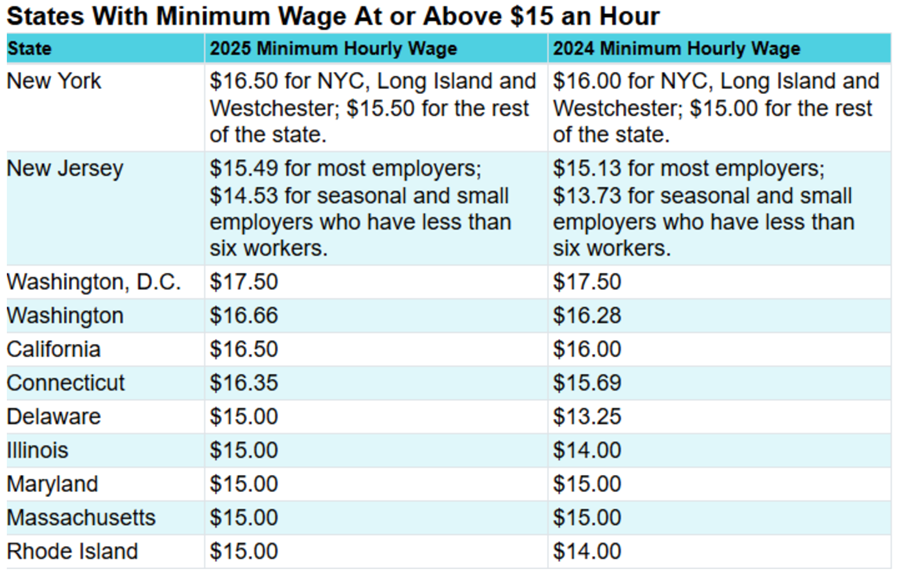
Minimum wage updated: In those states with a $15 minimum wage as of 2024, all except Washington are losing population, including Maryland that just raised its minimum wage to the magic $15 plateau.
11 states with $15 minimum wage also raised the rate even higher, except Maryland which raised their minimum wage to $15 as of January 1, 2025.
In addition, for the period from March 2023 to March 2024, the years employment statistics have been revised downward now by 800,000 million jobs. As new data coms in it also shows a decline in the # of full time jobs in the USA and an increase in the number of workers with 2 or more jobs. And that close to 100% of new jobs have gone to legal and illegal immigrants and not native born Americans. And in the last year, 800,000 more people are officially unemployed with the jobless rate 0.5% higher at 4.2%.
|

Will Rehab Help The Dismal Carter National Security Record?
by Peter Huessy, President of Geo-Strategic Analysis, Potomac, Maryland
With the passing of President Carter, the rehab folks within the Democrat party as well as some Republicans wishing to be “positive” about the former President have come out to tell us how good the former President did things, including former White House staffer Tom Donilon telling us that President Carter actually set the stage for defeating the USSR and winning the Cold War by initiating Reagan’s successful peace through strength strategy.
Who knew?
In addition, other security experts have been praising President Carter’s foreign policy record but largely for his work including at the Carter Center after the former President left office.
Well, as a 1980 political appointee of the Carter administration in the Interior Department and later a longtime 45 year-consultant to the Reagan and subsequent administrations and the USAF on military issues, I have a somewhat unique perspective about the two administrations. And what Mr. Carter did in office and after leaving office. Especially on defense budgets and security strategy.
Some of what Carter achieved was positive.
Such as starting aid to Solidarity in Poland and helping the mujahedeen in Afghanistan. But both were also largely Congressional initiatives and reactions to Soviet aggression in Afghanistan. (Remember Charlie Wilson’s War? That was when it was fashionable to trash the resistance in Afghanistan).
Unfortunately, former President Carter’s foreign policy record after leaving office was worse, and was the epitome of always blaming America and America’s allies first.
And most of what the Carter administration sought in foreign affairs failed and was mis-directed. His defense policy was poor. His national security strategy was worse.
These rehab analysts just get very much simply wrong. As President Truman once said, “You can look it up!”
For example, Tom Donilon writes in Foreign Affairs that Carter started the Reagan defense buildup.
Well let’s look this up.
The Ford Administration’s last DoD budget was for 1976—it was $157 billion. The Carter years were as follows: 1977 budget of $159 billion went up to $160 billion in 1978, then $164 billion in 1979, and then after the Soviet invasion of Afghanistan increased to $171 billion in 1980. [The Soviet invasion was December 1979.] So that is from $157 billion to $171 billion. $14 billion increase over four years.
This compared to the Reagan build up from 1981-5 that grew the DoD budget from Carter’s last budget of $171 billion to $235 billion in 1985, or a very significant buildup of $64 billion annually (all in 1982 dollars or adjusted for inflation.) The annual increases were $9, $13, $13, $13 and $16 billion in REAL terms.
In real terms, but especially in terms of requirements, the Carter budgets prior to Afghanistan went up all of 4% over 3 years and 9% over 4 years including after Afghanistan.
Now imagine campaigning in 1976---"Boy let me tell those guys in Moscow, we are going to be really tough. We are going to increase defense spending next year by $2 billion and then the next year by $1 billion. Boy that’ll show ‘em!” (The House in 1979-80 had 269 Democrats or a super majority so a very large defense budget increase could have been easily approved even if all R members opposed.)
During the Reagan administration the defense “buildup” (1981-85) was a real 37% or a nearly 400% greater build than Carter’s “buildup”. [All these numbers are from the Monthly Labor Review, August 1987, The Defense Buildup, 1977-1985 by Henry and Oliver.]
The initial Carter defense budgets went up all of $3 billion in the first three years or less than the Milcon backlog of housing rehab needs in 1980!
But only after the Soviet invasion of Afghanistan did the 1980 defense budget go up—by $7 billion but only when a majority in Congress demanded a defense buildup after it was leaked the administration would be cutting defense! (Remember Democrat Senator Edward Kennedy was threatening to campaign against President Carter from the anti-defense left.)
The Reagan administration inherited a hollow military/Army. There was no “Carter buildup.” Which was obvious from the trips I made with former SAC Commander General Russ Dougherty around the country in 1981-2 visiting military bases to determine the state of our arm forces readiness.
And if as Donilon claims everyone supported the defense increases that Reagan secured, why did most Democrats in Congress strongly oppose the Reagan buildup as excessive or not needed? Especially the $20 billion supplemental added in the spring of 1981 for the FY1981-2 defense budget!
Thankfully, some 40+ Blue Dog Democrats (out of 239 Dem members) in the House in 1981-2(where we would often lose up to 10 R members on defense votes) almost always gave us the defense support needed along with a handful of like-minded Democrats in the Senate where the 55-45 R majority still made things close.
Donilon says Carter actions started the successful campaign to end the Cold War but if so, why did the media and Democrats roundly criticize Reagan for not continuing a policy of detente? In fact, the very first questions at the President’s first press conference in January 1981 were whether the new administration would follow the SALT II arms deal (not agreed to by Congress) and continue a policy of détente, (which Reagan campaigned against!).
The NY Times said the Reagan administration had to continue the Kennan’s policy of containment and not pursue a roll back policy of the Soviet empire. (BTW Kennan opposed Reagan’s policies even supporting the nuclear freeze).
The Democrat party campaign of 1984 centered at stopping the Reagan defense buildup especially the nuclear mods and missile defense. Reagan won 49 states against Mondale.
Carter initially proposed major slow-downs in the defense budget, continuing detente, and the SALT treaty framework—which unfortunately allowed a huge Soviet buildup in nuclear arms. Then candidate Reagan in 1976 and in 1980 opposed all these measures—although not all Republicans agreed with Reagan to say nothing of the Democrat party leaders.
Only after the Soviet invasion of Afghanistan and strong criticism from Congress did the Carter Administration push for a modest defense buildup. But undercut the buildup by offline urging its rejection!
Carter withdrew SALT II from Senate consideration because it was going to be turned down as the Senate thought the treaty bad for USA security. But a treaty negotiated by the Carter administration.
It should be emphasized that the very modest Solidarity funding was started under Carter but due largely to Congressional initiatives, although it is a real plus for Carter. But only after the administration was strongly criticized by Congress for failing to stand up to Soviet aggression and Carter’s initial embrace of the Soviet leadership.
Reagan is often criticized for creating Al Qaeda as an outgrowth of the Afghan resistance. If aid to the mujahedeen in Afghanistan led to the creation of Al Qaeda, then why isn’t Carter guilty of creating Al Qaeda as well?
The facts are that the Northern alliance fought and defeated the Soviets long before Al Qaeda was created (1991) and then Al Qaeda fled to the Sudan during the Afghanistan civil war. The Taliban were created in the late 1990s by the Pakistani ISI and not the Reagan administration.
Carter never put funding in the budget for the US Pershing and GLCM Missiles to counter Soviet SS20s. Although promising to deploy the missiles if the USSR did not stop its own SS-20 deployments.
Carter campaigned in 1980 against Reagan’s policy of peace through strength saying Reagan was dangerous and trigger happy.
Carter’s administration opposed building a missile defense for the USA and continued to believe the ABM Treaty was the “cornerstone of US security.”.
The Carter administration failed to deploy the modernized MX missile or the B1 or B2 bombers or two thirds of the nuclear Triad. By 1980, the nuclear modernization effort was in a shambles and opposed by the nuclear freeze proponents which the Democrat party embraced. The freeze was in the 1984 party platform. And endorsed by the Soviets.
Carter said Khomeini was a “man of the cloth” and a democrat. Our UN ambassador (Andy Young) said Khomeini “was a saint…”
And Carter persuaded the French president to issue an exit visa to allow Khomeini to leave France and return to Iran.
Carter failed to support the Shah of Iran leading to the establishment of the world’s most prominent state sponsor of terror in February 1979. (Coincidentally, Saddam Hussein seized power in Iraq in July 1979 as did the Sandinistas in Nicaragua.)
And the US government indirectly campaigned against Thatcher in England through indirect State department funding of anti-Thatcher propaganda. (Obama administration did same re Israeli elections!)
Failed to protect the USA embassy and our diplomats in Tehran.
Cut defense spending in 1977-79 and led to the creation of the hollow army where USA defense capability was seriously degraded.
Gave the USA economy:
14% inflation
21% prime rate
Soaring oil and energy prices and gas lines.
Said USA would run out of natural gas by 1990. The White House environmental crazies opposed every realistic energy plan from Interior or Energy Departments. The administration wanted to basically nationalize the energy industry. My audit of the energy policy of the Carter administration, done for the DOE in 1982-3 concluded that the energy policy was a complete dud.
Continued the trend toward lower crude oil production and failed to successfully support overall US energy and mineral production.
Gave Eastern Europe communist countries massive loans and freed up cash for the USSR.
Welcomed the Sandinista victory in Nicaragua. Fully embraced the dictatorship in Romania. Said it was a new kind of socialism.
Tried to normalize relations with Cuba. Spent his post President work at the Carter Center giving a good housekeeping seal of approval to the elections in nations that were enemies of the United States.
Betrayed Taiwan by kicking them out of the United Nations and only recognized communist China as a UN member.
Made major trade concessions to communist China.
On Israel, it is assumed that the Camp David deal between Israel and Egypt was such a positive achievement ---for which the former president deserves great credit—but that this exemplifies the former President’s support for Israel. Not true.
Carter wrote a book claiming Israel was an apartheid state which led to half of the Carter Center board resigning.
He claimed VP Bush helped rig the election in 1980 by making sure the hostages were not released by Iran before the vote—using pressure from Israel on the Iran leadership.
Soviets took over some 16 nations in the 1970-80 period which accelerated under Carter. And then Carter gave control over operation of the Panama Canal to the Communist Chinese.
Carter said the USA must get over its “inordinate fear of communism.” Thus, he also mistakenly embraced detente. And said this just before the Soviets took over Nicaragua and invaded Afghanistan. And were making war against Columbia, El Salvador, Guatemala, and countries throughout the third world. The Soviets themselves were convinced that in 1980, the correlation of forces was moving against the USA and toward the USSR where “victory over the capitalists” was on the horizon.
The Carter administration was overall far too late in seeing the Soviet threat. And even then, went in opposite directions simultaneously. Good on Poland and helping the resistance in Afghanistan. But terrible on giving the USA a hollow military and an economy of malaise.
In 1979, in just one year, the mullahs came to power in Iran; the Soviets invaded Afghanistan; Hussein seized power in Iraq; and the Sandinistas seized power in Nicaragua. All four were key events in the rise of totalitarian and authoritative enemies of the United States, all allied with the Soviet Union, as well as sponsors of terror attacks against the US and its allies.
___________

Peter Huessy is a Member of the Montgomery County Republican Central Committee. Since 1981 he has been President of Geo-Strategic Analysis of Potomac, Maryland. He was a former special assistant to the Secretary of the Interior and consultant to the US Air Force. He can be reached at [email protected]