Turn a Private Perk into a Public Crossing
For the past five years a 35 mile hole has existed in the region’s transportation network. Since White’s Ferry shut down in December 2020, over a landing rights dispute on the Virginia shore, there has been no Potomac River crossing between the American Legion Bridge and Point of Rocks. That single closure ripped out a low cost, transportation efficient, low-carbon link that once carried 600 to 800 vehicles a day including commuters, service workers, cyclists, and weekenders who stitched together the economies of western Montgomery and Loudoun counties.
Now comes an opportunity that is both practical and poetic. U.S. Treasury Secretary Scott Bessent has publicly urged the International Monetary Fund to sell its country club property along River Road, the 285 plus acre Bretton Woods Recreation Center beside the C&O Canal and the Potomac. If the IMF is ready to divest, our region should be ready to negotiate a public- private partnership to provide a public park and to restore a river crossing we control.
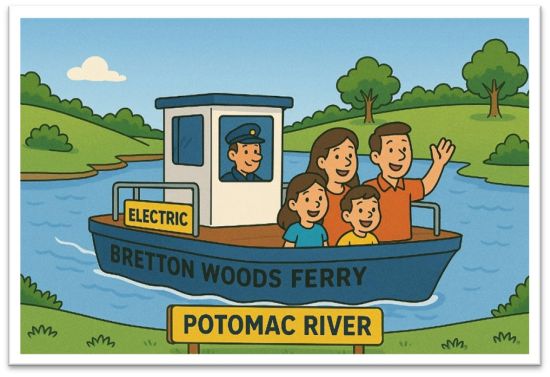
Call it the “Bretton Woods Crossing,” a modest, publicly owned, electric‑powered ferry and multiuse river link built on the Bretton Woods property on the Maryland side, paired with a landing on public land in Virginia where no single private owner can lock the gate. This would not be a Beltway‑scale bridge; it would be a right‑sized crossing designed to do what White’s Ferry did well: move a few hundred vehicles and many more bikes and pedestrians each day, keep trips local, and knit communities and labor markets back together without inviting sprawl.
The geography is on our side. Bretton Woods lies roughly a dozen miles downstream from White’s Ferry, close enough to restore the missing link for Poolesville, Darnestown, and western Loudoun, yet far enough from the Beltway to remain a local connector rather than a new commuter super‑route.
Why the Bretton Woods Crossing is the right solution:
- Public control ends the hostage situation. White’s Ferry failed not because a ferry is obsolete, but because one private easement on the Virginia bank became a veto on a regional lifeline. A crossing anchored to public land on both shores eliminates that single point of failure. The County’s joint study, commissioned after the closure, recognized ferry service as a valuable, feasible part of the local transportation network. However, the local Montgomery County Executive and County Council have failed to negotiate a solution.
- It’s affordable and fast compared to a bridge. A small electric ferry and two public landings can be built in a fraction of the time and cost of a new Potomac span, especially near Great Falls, where a bridge would face daunting environmental, historic‑resource, and scenic‑river hurdles. The National Park Service process still applies, but a low‑impact ferry that uses existing disturbed areas and limits wake and noise is far easier to permit than heavy bridgeworks.
- It protects the Ag Reserve and parklands. Because the site is not in the Ag Reserve and is large, queueing and parking can be designed onsite, keeping spillover traffic off rural roads. Most of the acreage can become public open space and integrated with the C&O Canal National Historical Park system improving river access and habitat restoration while reducing disturbance and reducing real costs.
- It restores resilience. When there’s a crash on the Beltway or flooding upriver, a small, reliable crossing saves hours and fuel. That’s why the 35‑mile gap in crossings is such a glaring vulnerability and why restoring some crossing in that gap matters more than restoring it in the exact same spot.
- It provides income for the County. That location does not have the infrastructure for housing or the fiber and power for a data center therefore the associated County tax income is not probable. However, setting up a public-private Potomac crossing entity could generate revenue for the County.
I offer that we should pursue both options of a White’s Ferry and Bretton Wood’s Crossing. Montgomery County has already put real money on the table in an attempt to secure a deal. Use a Bretton Woods acquisition as leverage, not just a substitute. If Loudoun can close a deal at White’s, terrific. If not, the Bretton Woods Crossing becomes the fail‑safe option that ends our five‑year stalemate.
The loss of White’s Ferry was never just about minutes on Waze. It drained foot traffic from Poolesville’s Main Street and severed everyday ties between two fast‑growing counties. A small, clean, well‑managed crossing, owned by the public and sized to the landscape restores those ties without inviting the unintended consequences of a massive new bridge. If you doubt whether demand exists, ask the residents who once used the ferry daily and the Poolesville businesses who miss them.
Next Steps:
- Signal interest. Montgomery and Loudoun should issue a joint letter to the IMF expressing intent to negotiate for the Bretton Woods property if offered for sale, with the aim of a conservation‑plus‑crossing project. Maryland and Virginia governors should back the move.
- Launch a 90‑day feasibility sprint. Direct agencies to evaluate two or three candidate ferry alignments tied to Bretton Woods on the Maryland side and public landings (i.e., Algonkian or Seneca) on the Virginia side, with a specific focus on electric propulsion, minimal dredging, and towpath protection. Use the 2021 study as the starting point.
- Choose the governance model. Stand up a bi‑county Potomac Mobility Authority (or fold it into the existing Parks/NOVA Parks structure) with a clear mandate: build and operate a small ferry, price it to manage demand, and protect the surrounding parks and the Agricultural Reserve.
- Keep White’s Ferry talks alive. If a permanent easement at White’s materializes, great, run both crossings seasonally and price to balance demand. If not, the Bretton Woods Crossing becomes the replacement.
A private riverfront club created for international officials out of postwar idealism no longer fits the region’s needs in 2025. A public river crossing heals a 35‑mile gap and provides a riverside park that welcomes everyone. If the IMF is ready to sell, the Washington region should be ready to buy, and to swap an exclusive fairway for a shared future across the Potomac.
As always, email me your thoughts at [email protected]